
How Schema Markup Makes Your Content AI-Ready
Learn how structured data can improve search visibility and future-proof content for AI and GPT-driven discovery.In this session, we’ll break down what Schema Markup is, why it matters for healthcare, and how it directly impacts your visibility in both traditional search and AI-powered systems.
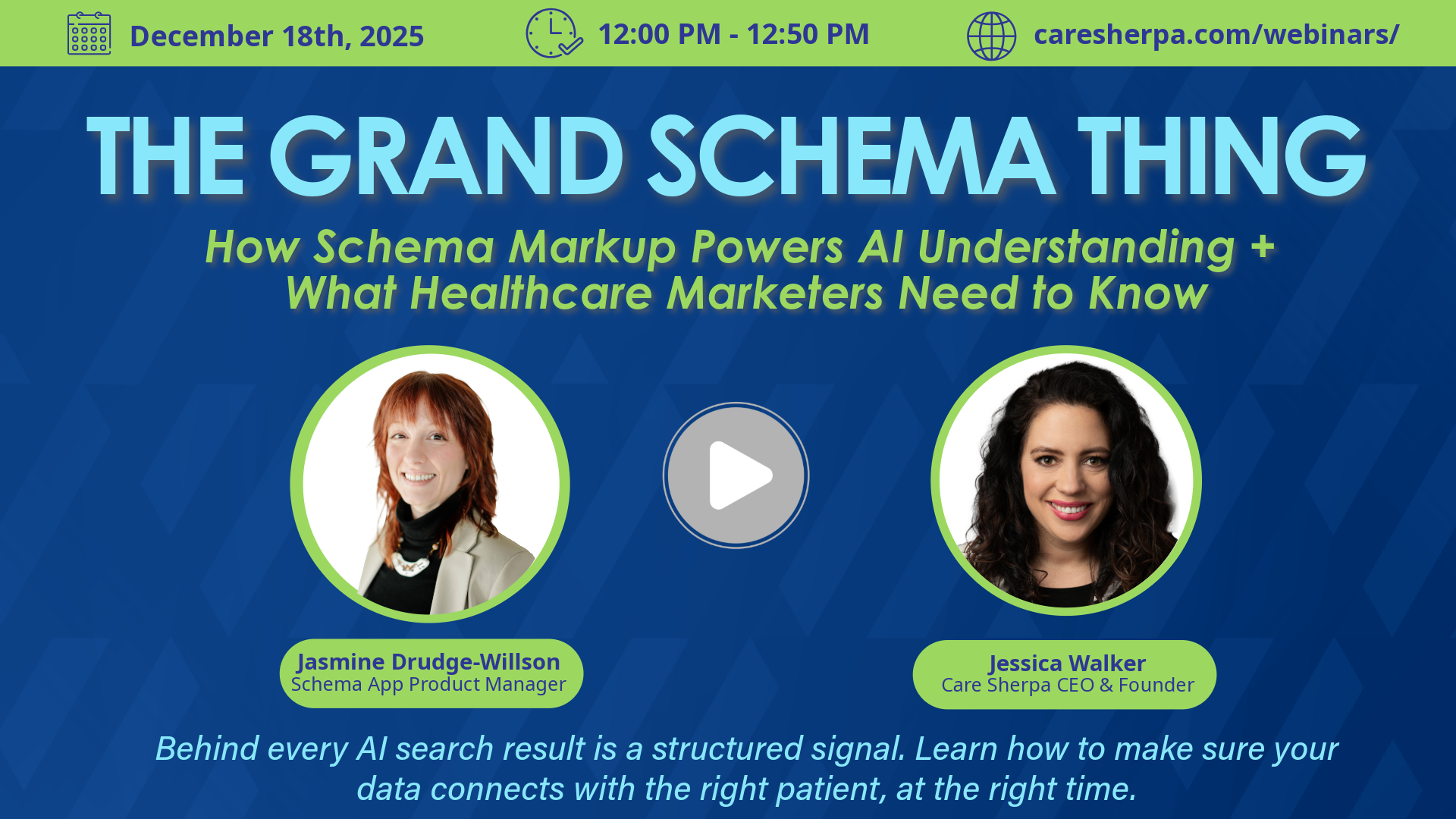
In today’s AI-driven world, search and patient discovery are evolving rapidly. Schema markup acts as a translator between your content and intelligent systems — helping machines understand what your pages are about.
In this session, we cover:
What schema markup is and why it matters for healthcare
How structured data supports both SEO and AI visibility
Common implementation mistakes to avoid
Practical prioritization strategies for 2026
How to align schema with your content and teams
Our Presenters:
🎤Jasmine Drudge-Wilson – Product Manager, Schema App
Semantic web expert helping healthcare marketers future-proof content with structured data and knowledge graphs.
🎤 Jessica Walker - CEO, Care Sherpa
National speaker and patient conversion strategist helping healthcare teams increase access and drive measurable results from digital engagement.
Transcript:
Jessica: Just a quick reminder and housekeeping before we jump in, is that during our conversation today, you do have the ability, and we encourage you strongly, to submit a question via our chat or Q&A, and if there's an appropriate kind of break, I'll jump in and either share it with Jasmine or during my section as we're sharing, but really want to make sure that you get your burning questions answered of all things schema as we are going.
Jessica: But now, because we have so many folks that are brand new to our series and have registered for the first time, I just want to take a quick moment and just introduce CureSherpa and why in the world we're hosting this series.
Jessica: So, I am the founder of Care Sherpa. My name is Jessica Walker. It's nice to meet all of you virtually. And Care Sherpa is really all about that last mile for patients. Once you have folks like Schema App and other partners that help you do all that hard work to get folks to come to your website, to show interest, to fill out a web form, and now what? And that's what Care Sherpa answers for you. We started this company because we found that 81% of healthcare leads never move forward. You do all the time and money to make that happen, and then ultimately, you end up that they don't actually get across the line and turn into new patients.
And that's what we want to help you solve.
Jessica: We do this through an end-to-end patient care service, so it's really that turnkey of managing from that first impression to that last impression of getting them to the procedure table, helping with some level of CRM and analytics around your patient pipeline, and then really supporting how do we optimize the patient experience and the journey along the way.
We focus on all things data. That's what we get excited for partners like Schema App today, because we work hand-in-glove with them to understand what we are hearing and seeing with the patients, why this matters, and how do we optimize for LLMs, your website, and beyond.
And why does this matter? Well, I'll tell you. We make a significant impact in your overall conversion rate. Our best practice clients are consistently above a conversion rate of 74%, so 85% higher than the industry average. So, most of you who are excited to get someone to come and have a consult, imagine if you could bump that even further to turn them into actual patients and conversions, and that's what Care Sherpa is about.
Jessica: So, as we're talking today, I'm going to be sharing a little bit more about the work that we do as an example of why we've been hosting this webinar. But to jump in, I'll turn it over to you, Jasmine, to share with us a little bit about the work that you're doing.
And as you're getting set up, I'll say I had the pleasure of meeting your CEO at a recent healthcare internet conference, and immediately said, Oh my gosh, you have to come on the series, you have to be a part of sharing it. I'd say that this has been one of the biggest topics, like, every single one of our webinar series, we've said, schema, schema, schema. And for those of you listening, it's probably felt a little overwhelming, like, what is this concept? So I think we're gonna break it down today, Jasmine, I’ll turn it over to you.
Jasmine: Thank you, everybody, for joining! I love talking about schema markup or structured data. Semantics is fully within my wheelhouse, and today we're going to help you understand how this powers AI understanding and what you need to know as a healthcare marketer.
Jasmine: So, one of the things that we love to do at Schema App is introduce ourselves using a knowledge graph. So, this knowledge graph is describing me as an entity.
And I have attributes and relationships with things in the real world and on the web. So if you look at my knowledge graph, you can see that my name is Jasmine Drudge Wilson, that I'm Canadian, I'm a product manager at Schema App, but you can also see that I'm an alumni of the University of Guelph, where I worked on the Lynx project and helped them develop a number of ontologies for building huge knowledge graphs with tons of research data.
Jasmine: Now, the thing about ontologies is that this is a concept that's a bit ambiguous. It has a different definition depending on if you're thinking about it in the information science sense, or from more of a more philosophical perspective.
So I've actually used the same property within my knowledge graph to state that the ontologies I know about are in the information science by linking it out to a Wikipedia article that defines that concept. And I would be able to help machines better understand or interpret all of this information about me as an entity if I expressed it on a webpage about me using schema markup.
Jasmine: So what exactly is schema markup? This is probably the best possible place to start, right? Well, as I mentioned, this is data that you add to your website to help search engines or other web crawlers understand your content with a much higher degree of accuracy.
It uses something called the schema.org vocabulary, which was actually developed back in 2011 by companies like Google and Yahoo, and Yandex that were really looking for, like, a lingba franca or an ultimate translator so that machines could better understand natural human language, which can actually be quite messy.
Jasmine: So, if you've heard about schema markup, you may have heard it under the term structured data. Both of these mean basically the same thing.
You've probably heard about it in the context of achieving rich results in the SERP, but what you may not know is that you can also leverage this as a reusable content knowledge graph. So this is a connected data layer that actually has significant implications for AI.
Jasmine: And if you're wondering what it looks like, it looks a little bit like this. I will not be showing you a ton of code, because it is not intended to be human-readable; this is for the machines to read. But in this example, the schema markup is describing Johns Hopkins Medicine, as a medical organization that has a legal name and a description and an area that it serves.
And that is the same organization that is also being described in Wikipedia, Wikidata, on LinkedIn, on Instagram, and if a machine were to interpret all of this, it would be able to better understand Johns Hopkins Medicine as an entity.
So, as I mentioned, depending on the schema markup types that you use, it can make your content eligible for rich results. So, like this video example that we see here, or that ever-essential and desired gold star review snippet rich result, which has significant implications when it comes to driving click-through rates, especially for physicians.
Jasmine: But schema markup does so much more than this, and it's really important for us to kind of get up to date on how the market is changing, to understand how the role of schema markup is evolving.
So, as recently as November, it was summarized in this report that we've got linked down here that Google and ChatGPT are dominating the search space, I think to the surprise of absolutely nobody. So, Google is still has the lion's share of the worldwide market for search engines at just over 90%, and ChatGPT is the preferred AI chatbot to be used in the US market at this time.
Jasmine: But what you may not know is that Gemini, which is owned by Google, is actually encroaching a bit on this market share.
What this goes to show is that Google is still the dominant player in the market. There's some disruption happening, but Google is very well positioned for this stuff because they have been working on developing AI solutions and prioritizing knowledge graphs for a very long time.
Jasmine: So it means that when big players like Google and Microsoft update their blog postings or their documentation to reiterate the importance of structured data, we were all ears, and a lot of other folks have been noticing that this is a trend that is coming up, and showing up as being more and more important when it comes to performing well on AI experiences.
So much so that some folks were starting to wonder if they should be creating completely separate Markdown files that are exclusively being, it's basically like a duplication of your existing web pages for LLMs only.
This, I'm gonna call it, like, a rumor, was going around to the point that John Mueller actually had to address it, to say, please do not do this. This is not helpful. The whole goal of the web is to make sure we're creating content that is accessible and important for human users who are going to consume it. So, you don't need to create separate Markdown files; just focus on having high-quality content, high-quality HTML, and then supercharge that content in HTML by including structured data.
Jasmine: And this has been a theme for months at this point, so Google Search Central in Live Dubai last October, they also reiterated that structured data is critical for modern search features, so kind of alluding to the fact that search features as we know it are changing.
In a recent blog post, Microsoft also got a little more in-depth regarding how you can optimize for AI search, and they called out schema markup as being a type of code that helps search engines and AI systems understand your content. So it is giving you this rich semantic layer.
And while there's no secret strategy for being selected by AI systems, regardless of what we may be hearing all over the place on LinkedIn or amongst our colleagues right now, success will always start with content that is fresh, authoritative, and structured, just as it always has been. And semantically clear content. And the semantic clarity is the piece that your schema markup can help with most.
So if you don't want to read that blog posting in full, don't worry, we have pulled out all of the key points for you. So if you are looking to optimize your content for AI, general rules are to ensure you're using structure in your content, like FAQs, headings, and Q&As.
Jasmine: Continue to focus your content on depth and authority and high-quality content.
Again, make sure you're using headings and page titles that are going to clearly summarize what your content is delivering, and make sure you're not hiding any key information, whether that be in walls of text, which are harder to interpret. Don't use PDFs if you can help it, and don't hide important things between tabs or expandable menus as well. While it may seem nice from a user experience perspective, it does hide that content from the machines that are trying to consume it.
Jasmine: And finally, for that semantic clarity piece, you want to ensure you're implementing schema markup.
But when we say that you should be implementing schema markup, we don't mean just, add some high-level, web page markup on every single webpage that you have. That isn't going to offer semantic clarity. What you really want to be prioritizing is creating high-quality, connected schema.
And studies have shown that the quality of the schema, not just the presence alone, can actually play a role in AI overview visibility.
But how exactly are we supposed to create high-quality schema markup? , if we're just scratching the surface of what schema markup is, it's helpful to know what the criteria are for ensuring that it is of high quality.
Jasmine: So lucky for you, Schema App, has been obsessing over this stuff for over a decade. Lots of us are really, really deep into the weeds of meaning-making and how meaning is interpreted and understood by machines. So we've kind of condensed our years of knowledge into a handy-dandy four-point checklist.
So we're gonna go through each of these steps and provide you with some examples as well.
So the first thing you're going to want to do is define using a schema.org type. So, if you have spent any time in the schema.org vocabulary, you'll have noticed that it has hundreds of types available to you for categorization purposes.
Jasmine: And that can get a little bit overwhelming if you're new to it, but a good place to start, especially if you're within the healthcare space, is to look at the medical section. So they've got a ton of terms that are specific to the medical and healthcare space, so that you can define things like medical conditions, medical therapies, specialties, physicians, drugs, contraindications. There's a whole swath of types of properties that are there for you to leverage. So what would that look like on an actual live website?
Jasmine: What you're looking at here is a page that represents a doctor named Eric, who works for Johns Hopkins, and you can see that the whole purpose of this webpage is to provide potential clients, really, or patients, with access to information to help them decide whether they want to book an appointment with this doctor.
So, knowing this, we would use the physician type to categorize the webpage, because the whole purpose of this page is to provide information about a physician.
And if you were to go to the actual web page within schema.org that gives you information about the physician type, you would see a short definition, but you would also see a list of properties available to you for describing this physician. And this is what you would implement to add depth to your schema.
Jasmine: So, you want to avoid using schema markup exclusively for rich results. Rich results are a great place to start, but you want to think beyond that. Keep in mind that you're basically translating your content to be machine-readable.
Jasmine: So you're going to want to ensure that you're using properties that are relevant and important for calling out the content that you have spent so much time creating to communicate out to your patients. So in our example here, I would call things out like the name of my physician, his medical specialties, whether or not he's accepting new patients.
I do have the ability to call out the aggregate rating, which would make this content eligible for that fancy gold star rich result in the SERP, which is still a great thing to be targeting. But I can also add richer information. What languages does the physician know? Are they a member of any other groups or institutions? And call out the description.
Jasmine: And I can call out potential actions that can be taken from this page.
So if somebody is looking to book an appointment, I can add structured data that calls out that they can do that from this webpage, and this ability to call out actions is going to become more and more important as web experiences evolve, particularly with agents.
Jasmine: So, once you've got some really good, deep, meaty schema markup, you're going to want to focus on breadth.
And by this, we mean implementing schema markup on all of the key pages on your website. Again, do not limit yourself to rich results only. I find rich results are a really great way to get started if you're just starting to familiarize yourself with the schema.org vocabulary, because it narrows the number of types that you need to be aware of.
But once you move past this rich results stage, you want to ensure that you are adding structured data to all of the webpages that are essential to machines and humans understanding the whole purpose of your organization's existence in the first place.
Jasmine: So, for a healthcare organization, that could look like adding it to all of your physician pages, if you have medical therapy or service pages, hospital or location pages.
Every single one of these webpages represents an entity or a concept of some kind that is really essential for providing information that's going to allow your patients to make well-informed decisions when it comes to scheduling appointments with you.
And once you've got your breadth down, which can take a while depending on the size of your website, you're going to want to focus on connecting. And connecting is what brings the context to your content by defining not just the entities, but the relationships between them.
Jasmine: And it could end up looking something like this.
So if I've got a physician page, I can now say that my physician has a hospital affiliation with a hospital that I've defined on another webpage on my website. And I can also state that this physician and this hospital both have an available service that's a particular kind of medical therapy.
And if I am looking to schedule an appointment with a physician out of a location that's near me, who specializes in a particular kind of condition or therapy, if the machines that I'm searching through have access to all of this rich metadata, they can surface this to me much more quickly and easily. So, a lot of what you're doing with your schema markup is defining and connecting your entities.
Jasmine: But when I'm talking about an entity, what exactly do I mean? This is a bit of a loaded term. So, at the highest level, a definition would be that an entity is a thing or concept with specific attributes. So, if this is, like, a t-shirt or a product, it might have a price or a color. If it's a hospital, it might have a parent organization. As you just saw within my own knowledge graph, I myself am an entity that has things like a name and an education, I'm an alumnus of places, I have a place of work as well, and all of this information can be conveyed to machines that want to surface information about those various entities.
Jasmine: And if you've heard the term entity in the past, it has probably been in relation to entity SEO. A lot of folks have asked us, What's the difference between keywords and entities? You may have heard, keywords are a thing of the past.
And really, the difference here is that keywords are just strings of text. So this would just be somebody typing in specific lines of characters, and then machines trying to surface content that matches those lines of characters. There's no meaning that's happening, there's no understanding that's happening.
Whereas when you shift your perspective and your strategy for content and SEO to entities, you're focusing your content on ensuring that you are describing unique, well-defined concepts that, again, have attributes and relationships to other things.
Jasmine: And the relationships to other things are providing all of this rich context that actually improves their understanding and ensures that they're surfacing the right content to people at the right time.
So if someone were to type in, for example, I love apple, in the past, maybe it would have surfaced something related to fruit, because apple is also the name of a fruit.
Jasmine: But there's enough context available on the web now, where if somebody says, I love Apple, inferences can be made, this is probably instead a company, and now they can service content about the company, as opposed to a fruit that has the same name.
And structured data, or schema markup, is the language that you use to define the entities on your website.
So, you're doing this automatically just by virtue of adding schema markup to your various web pages, but you can supercharge this knowledge graph data layer through a process called entity linking.
Jasmine: So, this is the process of kind of consuming all of the content on your webpages, and identifying the things that are mentioned within your content, and then automatically having those get connected to corresponding entities on the external web, or across your own website.
So this is kind of an ability to automate, adding a lot more context to your schema markup.
It has a number of benefits, including making your content knowledge graph way more descriptive, but it also provides a lot more clarity to AI and search engines and other web crawlers that are, again, consuming the schema markup that you have added.
Jasmine: So, we'll look at another example here, with our physician, Eric. He has a number of medical specialties. So, if I was to run all of that text through an entity linking process, it would identify a medical specialty like neurology.
And it would say, hey, this is actually a really well-defined concept, and there's information about it that exists within Google's own proprietary knowledge graph, within Wikipedia, and within Wikidata. And then it would embed within my schema markup links back out to those various resources using the same as property. Just like what I did when I was disambiguating the kind of ontologies I know about being about information science, not philosophy, we can do the same thing using entity linking across your own website content as well. And what's really cool about this is that the Google Knowledge Graph, Wikipedia, and Wikidata are all massive data sources that have been used to train a lot of the AI tools we're using on a daily basis.
Jasmine: Now, in Google's case, Google's is proprietary, but Wikipedia and Wikidata are both open source. And so, when you are referencing these other resources, you're actually pointing out to authoritative sources for these AI systems that are consuming your data.
And studies have shown that AI citations are influenced by both robust schema markup, but also entity-based SEO, because that can help you with building out your topic authority.
Authoritative content is 3 times more likely to be cited in AI responses, and if you're implementing schema markup to help search engines understand your brand and your content, that also is going to contribute to increasing your authority as well.
Jasmine: Now, here at Schema App, we've actually done some of our own testing, and we had some really great success with Brightview Senior Living.
So, they were looking to kind of leverage entity linking to help them with local search, and places are notoriously difficult to disambiguate how many Londons or Parises or Waterloos exist within the world, right? There are a lot of them. That means that sometimes this can be pretty heavy for machines to have to try to interpret. We can simplify this for them by leveraging entity linking to say, hey, this local business serves these various areas.
Jasmine: As you can see in the screenshot here, which is kind of more of a human-readable version of the schema markup, it is linking out to places and saying each of these places is the same place that has been defined over here within Wikipedia and over here within Google's own knowledge graph. So now the machines that are consuming it don't have to do any of that guesswork. They actually know exactly which places, or areas are served by this particular location.
Within months of us implementing this across Brightview Senior Living, they saw a 25% increase in clicks and a 30% increase in impressions for non-branded queries. It's been really interesting for us to see the impact this has had in non-branded search in particular, which we know is really essential to succeeding when it comes to your organic search strategy.
So this is just some additional evidence for you to understand that, yes, schema markup can help you achieve rich results. That is still good, that is still important, that is still valuable, but it goes way beyond that to actually helping you build a content knowledge graph, which is going to help with machine understanding.
Jasmine: I've been talking a lot about content knowledge graphs, which again is kind of a jargony term. Try to limit the jargon, but it's hard when you're in a really technical space. So, what do we mean when we say content knowledge graph?
This is a collection of relationships between the entities defined within the content on your website. This is what I've been showing you the whole way along, starting even just within my own first little visualization of my knowledge graph. And you're doing this using a standardized vocabulary, schema.org.
Jasmine: And new knowledge can be gained by inferencing based on the data that you have made available within your knowledge graph.Schema markup builds a content knowledge graph from your content. So, what looks to you like a bunch of code that's embedded in a web page is actually understood by machines in this way, where you have a bunch of individual entities that are well-defined, that are interconnected. And they can use this to help better understand your content and better answer questions that are being asked that are related to the products or services that you're providing. This is becoming more and more essential as we're moving into a very different world within search.
Jasmine: So, you've heard me say the word inferencing, and inferencing is so essential for machines to be able to answer your questions. And they infer things by understanding the relationships between things or entities.
One of the examples we love to use here at Schema App is, our CEO, Martha, who's in the big circle at the top there. She owns a car that was in the movie Losing Chase, which was directed by Kevin Bacon, which means Kevin Bacon actually used to drive her car. And based on this tiny little graph.
If that I know Martha. And you now know me, you can infer that you're 3 degrees of separation away from Kevin Bacon. And that didn't need to be told to you explicitly. That is something you could understand based on the relationships that were communicated to you in this network graph. So this is really where a lot of this magic happens. And the world at large is starting to understand how essential data that is structured in this way is to things like grounding knowledge graphs.
Jasmine: In fact, this Gartner report from the Hype Cycle for Artificial Intelligence for just this past year shows Knowledge Graphs as being in the slope of enlightenment. As somebody who's been highly invested in this very niche, nerdy area of computer science for a very long time, let me tell you how validating it is to finally see the rest of the world waking up to how powerful this technology can be, and the role that it is able to play is one of rounding. So, hallucinations and inconsistencies will continue to be something that is hard to cope with in terms of large language models.
Jasmine: Really, the ability to hallucinate, is kind of a feature. That's what's going to allow us to also be able to access new knowledge. But knowledge graphs can provide this foundation to provide you with more accurate, explainable, and trustworthy AI. It will help you take something that is a black box and turn it into a glass box.
And we've got links to a whole bunch of research, that is validating this. There's a lot that has been done historically, there's a lot of research ongoing to this day, but I want to draw your attention to the top bullet point from John Snow Labs, where they found that knowledge graph grounding achieved a 91% accuracy in clinical QA versus 43% with GPT-4 alone.
That is a massive improvement. So really, really powerful abilities come from pairing knowledge graph data with AI tools.
Jasmine: Now, it looks like we may have gotten a question that has come in here.
Jessica: Yeah, we sure did. The question was, is there an automated way using the schema app to apply ICD-10 codes to our structured markup using context clues from the page, rather than just us needing to apply every code through SA manually?
Jasmine: I love this question. Because there is kind of this ongoing debate about whether you want to have really high-quality schema markup, do you just go in and invest the time in doing that manually? There are solutions, like what we do here at Schema App, that actually allow you to automate a lot of these things.
So, we would be able to help you create a template that would map to various elements within the HTML of your webpages, and then we could auto-populate this piece of information within your schema markup, so long as it was visible within the webpage.
So that is kind of one of the standing rules within schema markup, is that you can only add structured data for content that is actually visible to human users as well.
Jessica: And a question that came in from another channel, Jasmine, related to the physician profiles that you talked about, and how do you support those from the Schema app up.
Is there a benefit to mapping when the individual providers have a care philosophy or care focus? Is there value in allowing for connection to any kind of schema markup strategy that way, or have you done any of the work with that?
Jasmine: Yeah, so with something like that, you would be limited by the types and properties that are available in the schema.org vocabulary.
This is where doing something like entity linking can actually come in really handy, because there are only so many categories that you can leverage from the existing vocabulary. What we have done in the past, though, is when people have written up little bios about their physicians so you get to know them as a person, we might run entity linking to identify the things that they know about. So there's a knows about property that we use all the time.
I used it to show you that I know a lot about ontologies.
And we're kind of expecting that to do some of that heavy lifting, where maybe they care about these things, or it has an impact on their philosophy. There's no properties that allow us to articulate that explicitly, but we can at least state that they know about various, methods or therapies, or that they have experience in certain areas, provided that has been communicated within the bio.
Jessica: So more than just, like, linking to maybe research papers they've been involved in, or research studies, or kind of the content they've had with different, let's say, news media, right? But actually taking that, having the backlinks, so that's still important, we know, for SEO, but taking it a step further and applying some strategy related to schema markup so that it can additionally expand the reach, if you will. That'd be maybe the approach to go after.
Jasmine: Yeah, exactly.
Jessica: Awesome. Had another question that came in, and keep them coming, folks, if you've got, as we've been talking, and we've got a little bit more to share, and we'll keep going too, but does the template basically apply schema to any new pages defined or mapped to a web directory, or do you have to manually add schema markup to each page? That's a big one. So, for example, if 20 new providers went live on a website, do you need to manually add each page, or does the template apply it to those 20 pages automatically?
Jasmine: So again, depends on your approach, right? If you're doing it manually, you're gonna have to go in and do it for every page manually, and anytime there's a content change, you need to have updating the schema as part of your workflow. And that's part of why ScheemApp came up with the solutions they did, because that was really time-consuming, right?
The way that we author markup is, if you had physician pages, for example, and they all lived under, a physician subfolder, we would set up a template that would deploy to every single web page that followed that particular folder structure, so it doesn't matter if the content updates, or if new pages get published, the schema markup would automatically deploy and update as changes were made.
Jessica: Just out of my curiosity, so in the case, like, maybe we don't have a complete profile for every provider yet, but we need to get the web page live, if that information is blank, does that impact the way the schema markup is going to address it or read it, or is it a detriment?
Jasmine: Yeah, I mean, you're always going to want to go for more robust content if you can, because we can only add structured data for content that is visible to users. So, we've worked with a lot of organizations in the past where they've had physicians that have really nicely fleshed out profiles, they've worked with a third party to get a bunch of anonymous reviews so they can get that star rating, they've got full bios, they've got videos.
And those kind of physician pages are going to perform better, both from giving more context to machines consuming it, but also for the humans that are actually coming to those pages to make decisions about their care. The more information they can access about a physician, the better.
Jessica: And just for our health system partners that are on the call today, or listening to the replay, I would say, and I know that's why you brought up Jasmine, like, this physician directory work is probably some of the best you can do to help from a visibility across multiple service lines. But I also recognize it's a pretty heavy lift as well. And so, just out of curiosity, maybe the last, you can talk with us, like, was there a way that you've broke down this project for partners in the past to help them, like, really, like, how do you, like, not try to eat the whole elephant at once?
Jasmine: Yeah, so what we have done in the past, I mean, we've done a lot of experimentation with a lot of different healthcare organizations and networks, where we will actually kind of test out, compare some pretty similar physicians, and do the pages perform better if, reviews have been added versus if they're not there?
Do they perform better if an image is present versus when it's not? So we have done testing, and obviously, there's a lot of different variables that can come into play, but this is the kind of work we've done to help them understand on a smaller scale, is the juice worth the squeeze, basically, right? So, is it going to be worthwhile to get those aggregate ratings added? It always is if you can, but that is something that is resource intensive.
Jessica: Fabulous. Well, we'll pop back in and keep going as we get more questions. Thanks, Jasmine.
Jasmine: Awesome, alright. So, back into all of this.
The reason that this is so imperative for healthcare in particular is that, based on the most recent AEO and GEO benchmarks report from Conductor Healthcare, by far, has the highest percentage of search queries that are triggering AIO results by industry.
So, if you get nothing else from this webinar today, the TL;DR is ensure your site is marked up using high-quality structured data, and that's going to assist significantly with reducing AI hallucinations and brand risk. It's really something that helps put you in the driver's seat when it comes to dictating how machines are going to be interpreting the information that you are publishing on your website. The reason for this is because schema markup is that bridge between your brand and AI understanding.
Jasmine: And we've done, like, a lot of thinking about how all of these pieces fit together. And so we've created something called the Value House, which starts with schema markup as your foundation, right? So when I took you through those four steps of creating high-quality schema markup, that's the first thing you're going to want to make sure you focus on.
Then it would be supercharging your schema markup with entity linking. If you have your own internal business taxonomy that you also want to leverage to kind of help with grouping together various entities within your graph, you would work on developing some kind of a topic taxonomy. And all together, this is going to build a really, really rich data layer known as a content knowledge graph. And this then supports 3 different pillars.
Jasmine: So, the SEO pillar there on the left, this is one that I think anybody who knows about schema markup or structured data is already well aware of, right? So this is your rich result play, your non-branded play, ensuring that you're getting high-quality traffic and improving click-through rate by virtue of having those nice decorated results.
But you can also use this rich metadata to surface content insights and content opportunities to help inform your content strategy so that you are ensuring that you are working on the things that are going to improve the quality of traffic and increase website conversions overall.
But it's really the last pillar that I think many of us are most excited about, which is AI and innovation. This is happening, it has been happening, for years at this point, and the way that people are interacting with and accessing information is evolving and is going to continue to evolve. So, right now, you can invest in implementing schema markup to improve the accuracy in large language model responses.
But it's also going to ensure that your data is ready for agents in the agenda web.
Jasmine: And the agentic web is the new version of the web that really is, like, the biggest thing to come since the invention of HTTP. And this is something that you're really going to want to make sure that you're aware of, and that you're ready for.
So, as I mentioned, myself and many of us here at Schema App are self-described semantic technology nerds. We, like, live, eat, breathe the stuff. So this Scientific American article that came out way back in 2001, that's 25 years ago, almost 25 years ago.
Described a vision of this semantic web that would enable software agents roaming from page to page to execute sophisticated tasks for users.
So this was written 25 years ago by Tim Berners-Lee, the founder, basically, of the internet, alongside Oral Asla and James Hundler. And when I was learning more about what was going on with the agentic web, all of these alarm bells were going off, that the agentic web is this vision of the semantic web in motion.
Jasmine: So, this is going to empower AI-powered agents to not just look up information, but to do things for us. Coordinate tasks, connect services, make recommendations on behalf of your customers. So, things like booking an appointment through a physician. If a user has to go through doing all of this research first, and then trying to figure out how to set up their appointment, there's additional friction that takes place.
And the agentic web is promising a future where a lot of that friction is removed. The human being still sits in the driver's seat when it comes to making decisions.
But all they would have to ask for is, book me an appointment with a high-quality physician who specializes in XYZ services in this kind of an area, and boom, they would be able to take that action to book that appointment with the physician that was surfaced.
Jasmine: So, the Agentic Web is a thing of the future, but it is also already happening now. And we're seeing this come into fruition through things like the Agentic Commerce Protocol that's being developed by OpenAI and Stripe, but also with the NLWeb project, which was just recently announced by Microsoft this past May. So, the goal of the NL Web, or the Natural Language Web, is to make it easy for any web publisher to create an intelligent, natural language experience for their site.
So you can really think of it like, your search bar no longer being that basic keyword search, which a lot of users, including myself, tend to find quite frustrating. Instead, the search box becomes a conversational AI agent, so people can ask longer, more complex queries and actually get the content from your website surfaced to them in a way that is going to answer the questions that they're asking. They're not going to have to sift through. As much information, it's reducing a lot of that friction.
And NLWeb is something that was created by RV Gua, who, funnily enough, also created schema.org.
Jasmine: And our co-founders, Mark and Martha, actually met with RV Guha to talk about how we can work together to help with preparing for this Agentic web. And RV Guha remarked how important schema markup is going to be, because it will prevent hallucinations.
So, when it comes to being agent-ready, there are really 3 different pillars here. We've got the knowledge graph you need to have, which needs to be accessible to machines. It needs to be correct, and it needs to be complete.
And then you're gonna have to set up Agentic entry points, so this would be, like, a registry of actions into your business. This is something that is just in the process, kind of, of being defined, so there are no actions you can take here quite yet.
Jasmine: And then in terms of AI governance, they still will need to figure out things like trust, accuracy, compliance, and open standards. So this is a big project, right? But by building out your knowledge graph, that is going to set you up for the rest of the work that will take place in order to be agent-ready.
Jasmine: What makes this so essential is the degree of control that it gives you as an organization. One of the biggest challenges that we're hearing from a lot of people is this kind of anxiety around giving up control to machines that are making decisions for them.
And the structured data or schema markup data layer is going to mitigate a lot of that risk. So the current state when it comes to the Agentic web is there's a lot less control, right? So agents can access your web directly, and really, you need something like an MCP or NL web to help you get ready.
Jasmine: So MCP is like a point integration, so it gives you some element of control. So, it will define how agents can interact with your site. And you'll be able to integrate to be able to root into the MCP server, and this will use your content knowledge graph as an authoritative source behind the server, so it's defining a bit of the rules that they need to abide by when it comes to how the entities within the content are related to one another, and how they can show up within responses when it comes to actions that are attempting to take place here. But what's even better is the NL web, which is going to give you full control. So as I mentioned, this is like a built-in conversational interface.
But it would also leverage an MCP server to give agents a standard way to consume your data, and allow the open web to talk back to you. So it's creating this whole new world of interactions between users, agents, and web content.
And the result of this is a controlled experience. So you've got your content knowledge graph grounded with real data. Every statement within your graph is like a fact, basically. And it means that the agents are not going to be guessing about which actions they can take. They will explicitly have to follow your instructions.
Jasmine: There's something about that level of control that we found really gives people a sense of calm at a point in time when things feel very tumultuous. So, regardless of the direction that things go in with AI, data, and high-quality, well-structured data is always going to be essential. It doesn't matter what tools are consuming it, it doesn't matter who ends up winning out when it comes to market share, structured data is going to be valuable.
And Gartner released, even way back in February, that a lot of organizations were already struggling with having AI-ready data foundations. Creating these trusted data foundations, which are going to be really essential to enabling those AI-driven business outcomes.
So, I'm gonna take you back again to this value house.
You are able, using schema Markup, to build this incredibly strong foundation, which sets you up for success immediately with conventional SEO can help you surface a lot of insights within your own content, because you have a rich metadata layer, and it also ensures that no matter what happens in terms of AI and innovation, you are going to be ready to make empowered decisions around how you control access to the way that your content is understood and the interactions that the agents of the future can take.
So, it's a very exciting time. I do invite you to scan the QR code here if you would like to download our ebook, Mastering AI Search Essential Strategies and Insights, and if there are any other questions, I'd be more than happy to answer.
Jessica: Jasmine, this has been phenomenal, and anyone that has followed any of our series, we've talked about schema markup every single time, because it is such a foundation, and would it be fair to say, when you think about the big long-term strategies, like, if you do nothing else to think about your future kind of proofing for LLMs and beyond, this is where you start, and be very tight with your overall strategy approach. So, as you're thinking about providers that are on our call today. Here we are at end of the year, they're making their plans for next year. What is, like, the number one recommendation to say, if you start one place, start here, where would you say?
Jasmine: Yeah, I would say focus on getting schema markup implemented on your physician and location pages.
If you were to think of a hierarchy of how important your content across your website is, especially if you're dealing with vast amounts of content, what are the most informative webpages that patients in particular are going to want to be able to access when it comes to making well-informed decisions about their care? It's the physician and location pages.
Jessica: And then, another question we get asked frequently, when we've talked through these future kind of proofing, in some ways, it's difficult, because maybe our executive team doesn't always understand the concepts of what we're trying to then ask for budget lines and support and resources for. How have you guided providers to, let's say, our health system partners, to go and get that executive-level approval for budgets or partnerships or things that are going to really make a difference in this approach?
Jasmine: Yeah, I think it can be really hard to get buy-in, especially for more future-oriented things. So, what we found really helpful is that schema markup is still incredibly valuable when it comes to conventional SEO.
Right? So you still are able to leverage this for things like achieving rich results, the traditional measures of clicks and impressions and click-through rate, it will have a positive impact there as well. And so, it allows you to get the organization to invest in something that will have immediate positive effects, while also preparing you for the changes that are coming down the line at a kind of a higher level, when we're talking about how the future isn't completely certain, right? But, the things that remain true when it comes to structured data, it’ll always be faster to process, which means it is cheaper to process, and it will increase accuracy. That's like 3 for 3; When people tell you, like, out of 3 things, you can only pick 2, like, you have to give up one, you don't have to, because structured data is going to enforce three different key elements that are going to be really essential to AI success.
Jessica: So anyone that's thinking about a website redesign or a lift and a shift to a new partner, anything kind of CMS in the platform, this should be first and foremost a significant part of their strategy, of what does this look like when you're going through, because if they obviously don't have it, maybe on their current pages, but then it has to be a core foundation going forward. And I dare say that any partner worth their salt should be bringing this to the forefront of the conversation as well.
Jessica: Yeah, absolutely.
I want to share a little bit, too, as, again, talking about, CareSharpa and the role that we do, and how we have been a part of these conversations, because we're with patients as consumers, right? So before they become a patient, they're a consumer. They're considering you and your partnership. So we go through that qualification stage, that scheduling stage, that following stage. And so, for us, I wanted to share a simple case study that we had with a partner recently, is along this line of how do we work towards a schema markup. So we're helping support a prostate health initiative, and one of the things that we found across every chat, every conversation, is that the number one most dominant question was around sexual dysfunction. And then it was, specifically, interestingly enough, related to even conversations around lung and other factors. So considering this, going back to what the patient talked about every time.
And then we then helped to get that executive buy-in for the benefit of schema markup to say, okay, let's just focus on this one service line that you're already investing significant marketing spend into.
And let's spend the time to help you support your schema markup related to this. So, searching through the chats, searching through, all of the, transcripts of every conversation we had, and the frequently asked questions, etc.
We focused on these core areas of when someone is a good candidate, and what are the costs related. These are the commonly asked questions by consumers, right? What's the recovery process, the timeline for both the procedure of how do I get ready for the procedure, what do I need to be prepared for after, and then, interestingly enough, a frequent question of, like, how long does this procedure take? Is it a couple of hours, an hour? What's the anesthesia, etc?
Jessica: So, going through these most commonly asked questions, and then tying that to make sure that every content page hosted these, and then was answered specifically in the schema strategy. So in a small service line example, really focusing on this to demonstrate that, yeah, when we make this foundation investment, it does make a difference in our visibility.
This client started with less than 10% of new leads coming from an LLM for an attribution. After, for this service line, we saw, within about a 60-day period, it was a 45% jump of those who were attributing to LLMs because of addressing these questions.
So, I like to say, for those of you listening or following along at home, as you think through your approach on this, if you, again, maybe the budget lines to work with someone like a schema app, but then starting here to show the business case that this really does drive consumer-based behavior. We see it every day. Again, that's why Care Sherpa is hosting this session.
Jessica: So, as we kind of wrap up, I wanted to, again, welcome everyone to go ahead and send in any final questions you may have for Jasmine around the work that she's done, or some of the ways that she's helped health systems and partners, but also, encourage you to find us on LinkedIn as well. I know, Jasmine, you're pretty active on LinkedIn, as is myself, and we'd love to continue to engage the conversation.
Jessica: And then, Jasmine, as with our other presenters, has been so gracious to also offer up a variety of toolkits. So, going to Care Sherpa’s page here, the GPT-AEO-GEO toolkit, you'll find resources and some of the studies that Jasmine mentioned today during her presentation. So, as you're thinking about how do I align strategy, how do I align, Ultimate, like, the investment in people and resources to get there.
She's offered some fantastic tools along the way to help you, and again, this presentation will be available for you as well.
Jessica: Alright, let's open it up to another couple questions. Let me just see here,
Another question came in, you mentioned, we talked about earlier, like, starting with your physician pages, location pages. Can you say a little bit more about some of the optimization you've done with location-based schema, and how that's come about to show a difference?
Jasmine: Yeah, I mean, the entity linking is a really big one. We have also noticed within the large language models, some of these concepts that are harder to disambiguate between really, really benefit from the implementation of schema markup and the entity linking. We actually had an example, one of our healthcare organizations, I believe one of their locations had, like, the wrong office hours were being shown, and so just by changing the schema markup, doing nothing else.
Jasmine: it ended up writing itself, and now the correct information was available, and that is going to have a big impact on whether or not patients will go in and try to access care. If they don't think you're open, they're not going to go, right? So, it's been really interesting to see, as time has gone on, the different ripple effects that the modifications to schema can have, and then also being able to kind of track this in using traditional SEO metrics, like what you have available to you within Google Search Console as well, in terms of increasing visibility, and also in terms of increasing click-through rate. So, physicians are a big one, and I think, like, one of the best things you can do there is, to ensure that you're talking about what they specialize in. But if you can get the aggregate rating information as well, that will make a big difference when it comes to conversions.
Jessica: One of our prior presenters was RatingsMD, and that was another significant part we know, like, makes such a big difference. So, along the lines with locations, we know that some of our larger health systems struggle with that directory management, right, with rogue pages, or rogue Google Business Profiles. Is that kind of a precursor? Do we need to correct that before, or can this, if we do it on our own pages, help address that, and help us overcome any directory management issues we may have?
Jasmine: So, there still is that kind of challenge of the fact that the schema markup can only ever communicate what's already being communicated within the contents of the webpage, right? So there is, like, some content management stuff that is still going to have to be managed alongside the structured data, but we have found that if you're able to have a solution where the structured data is at least automated, it means you don't have to worry about making any changes to the schema markup, you can just focus on updating your content.
Jessica: Yeah, absolutely. And then in terms of the “beyond,” when we think about, let's say that's, like, maybe that kind of foundation level, what would be the next recommendation you'd have for someone as they're thinking about that next kind of graduate level of, like, okay, you've got your foundation built, now let's put the house upon it?
Jasmine: Yeah, so, I mean, making sure you've got it on your key entity pages first is ultra-essential, but then you would want to start implementing it on some of your supplementary content, right? Like your blog postings that are telling stories about the organizations. But the whole purpose of those kind of secondary or tertiary pages is to provide more context about a lot of these entities that you've already described on individual webpages. So, when you implement markup on these kinds of secondary pages, you can have them link back to these physicians, or the services, or the locations even if you don't have the hyperlinks embedded in the content like you would for human users, it's a great way for the machines that are consuming it to also understand, oh, this blog post happens to mention a physician who is described over on this webpage, and now I can go over there and consume all the structured data so I understand that entity better. And that's going to come in really handy as kind of a longer-term, more fleshed-out strategy.
Jessica: Yeah, and I'm thinking about how some of these things can happen concurrently, right? So it's not one, then the other, and a link in a chain, so definitely, like, there's some foundational pieces, but I'm imagining some of our listeners who are part of a larger health system that have multiple departments, right? So how do we get everyone on the same page? And that's what you talked about governance, right? So having consistency, so that as we build new content, this is always part of how before we go live and push the content.
Jessica: So, whether that could be our content team with any of their blog posts, like, just incorporate this. Don't wait, right? Start it today. And, is there a benefit to go back to historical stuff and start to clean that up as well, or just move it as a forward-looking thing?
Jasmine: Yeah, so one of the things that we found really interesting about implementing entity linking, so we'll run entity linking across an entire website, and then it will give you a report that shows these are all the entities that we found, and these are all the webpages we found them on, and then it's giving you kind of this high-level entity audit, basically. So, you can now make well-informed content strategy decisions based on known metadata about your existing content knowledge graph.
Jasmine: And we've had a lot of success with that as well.
Jessica: So basically, I already look at where your most traffic, activity, and current readability for LLMs is or is not, and then address that as a priority. So there is value, then, in going back to some historical pages that are constantly producing, but then giving them a supercharged boost, right, with the schema amendments.
Jasmine: Exactly, yeah, or even identifying opportunities to do some cleanup. So we had one organization that didn't realize, like, COVID-19 was one of their top entities that was identified. Why are we talking about this so much? And we realized it was because they have been starting all these blog postings with, in this era of COVID-19.
So now you've situated your blog post at this really particular point in time, right? So we surface this data for them with the entity audit, and they could go in and remove that, and then make the content a bit more evergreen, because it wasn't so focused on a particular point in time.
Jessica: That's a really interesting concept, I hadn't thought about that, but yeah, I mean, being able to also use this to recycle your content, make it evergreen, clean it up in the current model. You've already got it out there, let it get to work for you and produce. Oh, amazing.
Jessica: Well, as we close up, any other parting kind of suggestions, thoughts, or anything else that our listeners should consider after your amazing presentation today?
Jasmine: Just don't be afraid of what's coming down the pipeline with the future. I think it's been a really volatile last couple of years, and it's going to continue to be that way. But I, a thing I really appreciate about our CEO, Martha, is anytime things get wild, she'll say, “Okay, but what are the facts?” And that's when I go back to knowing that schema markup is going to build something that offers a level of stability, so regardless of how wild and crazy things are going to be in the future, I still get to maintain this kind of sense of control over at least how I'm being understood. And that helps me sleep at night.
Jessica: I love that. Well, we talk about that with the, you have the feels, so what are the reals? The reals are here that we know — No matter what, this is a great investment as things continue to change, because I use this as a great example. We started this series in June, right? And at that time, LLMs were loving everything Reddit, so we're like, hey, optimize for Reddit. Now we know, right? That's no longer the core. But again, if you had invested in that schema markup, that would continue to serve you, even as the models adapt and change, and like you said, the agency and all that that comes along.
So, fantastic. Well, we'd love to continue the conversation online with you, as we've shared our LinkedIns, and Jasmine, I just want to, again, thank you for being a part of our session today and part of our series. You brought so much great content and so much actionable insights for all of our listeners, and just appreciate the time you spend with us today.
Jasmine: Thank you so much for having me, it was great.
Jessica: Thanks, everyone. Have a great rest of your day.